

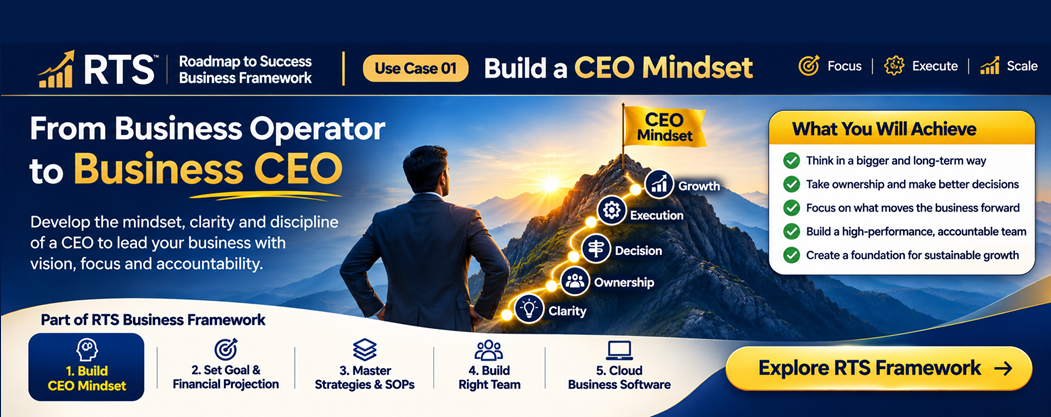
Build a CEO Mindset
From Business Operator to Business CEO
Introduction: Your Business Can Grow Only as Much as You Grow as a Leader
Many entrepreneurs start their businesses with passion, expertise, and a strong desire to succeed. However, as the business grows, they often become trapped in daily operations—handling customers, managing employees, solving problems, approving decisions, and monitoring every activity.
The business may generate revenue, but the owner remains its biggest dependency.
The real transformation begins when a business owner stops thinking only like an operator and starts thinking like a CEO.
The RTS Business Framework (Roadmap to Success) begins with its first and most important lever:
Build a CEO Mindset.
This use case explains how entrepreneurs can develop the mindset, clarity, and leadership discipline required to build a scalable and sustainable business.
The Challenge: Business Owner or Business CEO?
A business operator focuses primarily on completing today's work. A Business CEO focuses on building a business capable of delivering results consistently.
| Business Operator Mindset | Business CEO Mindset |
|---|---|
| Focuses on daily activities | Focuses on business outcomes |
| Solves every problem personally | Builds systems to solve problems |
| Reacts to situations | Plans and anticipates |
| Controls every employee | Develops accountable teams |
| Focuses on immediate revenue | Builds sustainable profitability |
| Works inside the business | Builds and leads the business |
| Depends on personal effort | Creates organizational capability |
The objective is not to stop understanding operations. It is to develop the ability to lead operations without becoming the bottleneck.
What Does Building a CEO Mindset Mean?
Building a CEO mindset means developing the ability to think strategically, make informed decisions, take ownership of business outcomes, and create an organization that can perform beyond the owner's individual capacity.
1. Think Beyond Daily Operations
A CEO must regularly step back from routine activities and evaluate the bigger picture.
Ask yourself:
Where do I want my business to reach in the next 3–5 years?
Which customers and markets should we focus on?
What is limiting our growth?
Which activities consume my time without creating significant value?
What should the organization become capable of doing independently?
2. Develop Clarity of Direction
Without clarity, businesses frequently move from one opportunity to another without consistent execution.
A CEO should define:
Business vision and long-term direction
Revenue and profitability targets
Target customer segments
Key business priorities
Growth strategies
Organizational responsibilities
Clarity helps the entire team understand what matters and where to focus.
3. Take Ownership of Business Results
A CEO mindset begins with ownership.
Instead of blaming employees, market conditions, or competitors, effective business leaders examine the systems, decisions, resources, and leadership practices influencing results.
Ownership does not mean doing everything personally. It means taking responsibility for creating the conditions in which the organization can succeed.
4. Make Decisions with Business Intelligence
Business decisions should not depend entirely on assumptions, emotions, or incomplete information.
A CEO should develop the habit of reviewing:
Revenue and profitability
Sales pipeline and conversion
Customer retention
Employee productivity
Cash flow
Operational performance
Business risks
The right information enables better decisions and timely corrective actions.
5. Build an Accountable Team
A scalable business cannot depend on the founder's continuous supervision.
The CEO must establish clear expectations, assign ownership, define performance indicators, and create a culture where employees take responsibility for results.
The objective is to develop leaders and teams who can independently manage their responsibilities.
6. Focus on High-Value Activities
The CEO's time is one of the most valuable resources in the business.
Instead of spending the entire day handling routine matters, the CEO should prioritize:
Strategy and business growth
Key customer relationships
Financial planning
Leadership development
Process improvement
Business expansion
Organizational capability building
Routine and repetitive activities should gradually be standardized, automated, or delegated.
RTS Practical Implementation: 5 Steps to Build a CEO Mindset
Step 1: Conduct a CEO Time Audit
Track your activities for seven days.
Identify:
Activities only you can perform
Activities that can be delegated
Activities that can be automated
Activities that should be eliminated
Step 2: Define Your CEO Priorities
Choose three to five priorities for the next 90 days.
Examples:
Improve sales conversion
Increase profitability
Reduce customer complaints
Develop second-line leadership
Improve cash flow management
Step 3: Establish a Business Review System
Create a weekly CEO review meeting covering:
Sales performance
Financial position
Operational performance
Team accountability
Customer satisfaction
Pending decisions
Action plans
Step 4: Delegate Ownership, Not Just Tasks
Every important responsibility should have:
A clear owner
A measurable expected result
A defined timeline
Required resources
A review mechanism
Step 5: Create a CEO Learning Routine
Invest regular time in developing your leadership capabilities.
Study business strategy, finance, people management, decision-making, technology, and execution.
Your business growth requires continuous growth in your leadership capabilities.
The Transformation You Can Achieve
When business owners consistently develop a CEO mindset, they can progressively build:
Greater strategic clarity
Better business decisions
Stronger leadership teams
Improved execution discipline
Reduced dependency on the founder
More predictable business performance
A stronger foundation for sustainable growth
This transformation is gradual. It requires discipline, consistent practice, and the willingness to change established working habits.
Build Your CEO Mindset with RTS Business Framework
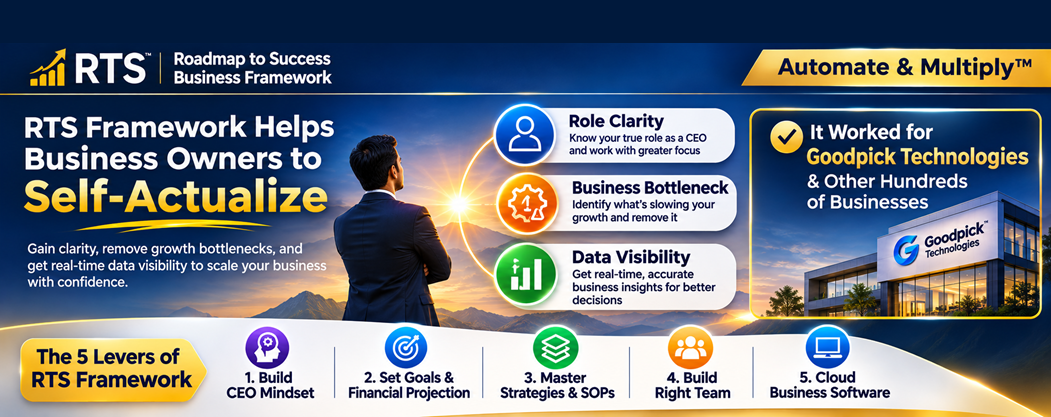
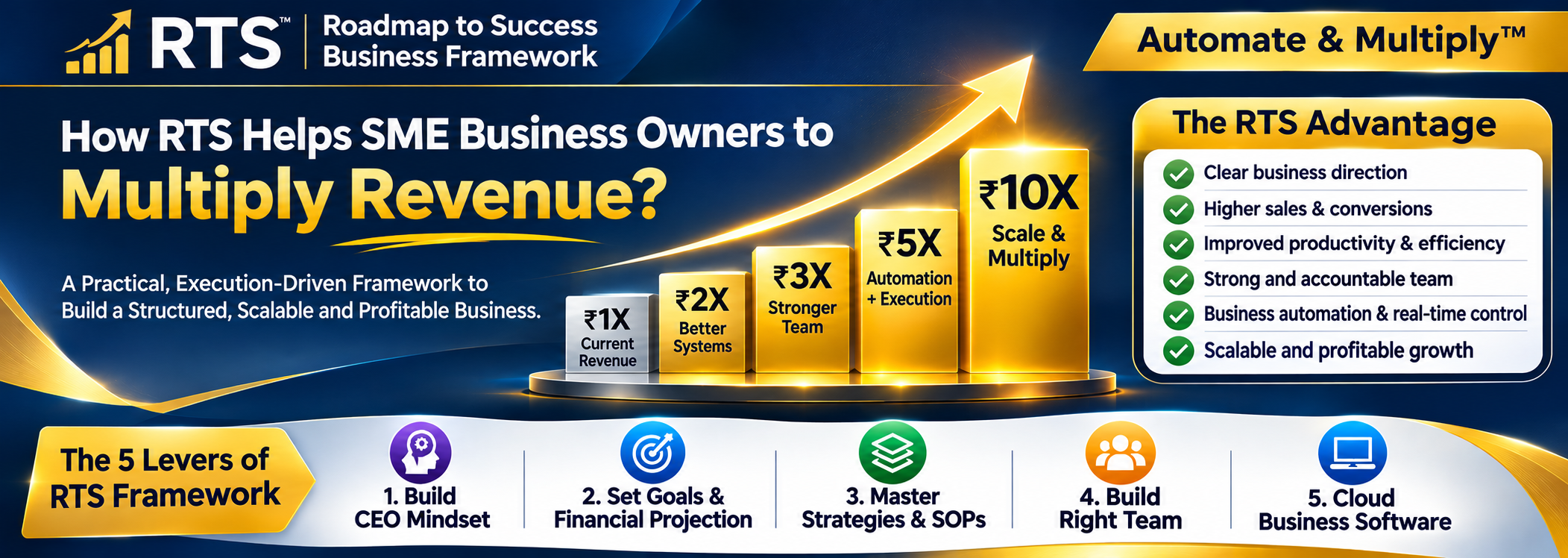
The RTS Business Framework (Roadmap to Success) is designed to help entrepreneurs transform their businesses through five interconnected levers:
Build CEO Mindset
Set Goals & Financial Projection
Master Strategies & SOPs
Build the Right Team
Cloud Business Software
The first lever establishes the leadership foundation for the remaining four.
A business cannot become scalable if its CEO remains trapped in daily operations.
Start building the mindset of a CEO. Create clarity, take ownership, develop your team, and lead your business toward its next level of growth.
Think Like a CEO. Build Like a Leader. Grow with RTS.
Explore RTS Business Framework
Discover how the Roadmap to Success can help you build a more structured, accountable, and scalable business.






No comments found